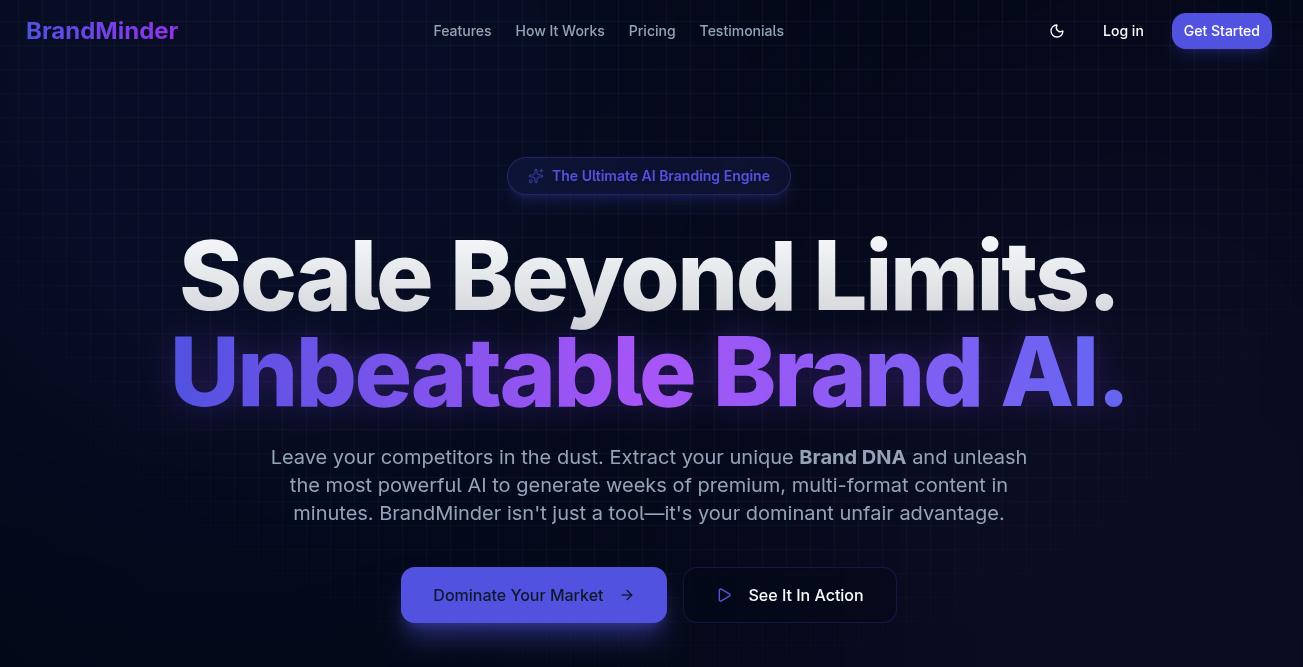
BrandMinder — Autonomous Multi-Agent AI SaaS Platform
Autonomous multi-agent AI SaaS platform orchestrating distributed research, positioning, and content generation pipelines.
What was broken before this system existed?
Founders and technical creators spend 15+ hours weekly struggling with consistent personal branding, research synthesis, and audience targeting. Existing generative AI tools produce generic, robotic copy with zero strategic continuity or industry-specific depth.
What did I actually engineer and own?
As the Founder & Full-Stack Engineer, I owned the system end-to-end: from initial requirements definition and architectural design to database schema modeling, backend pipeline development, and final production deployment.
Engineered an autonomous multi-agent pipeline where specialized AI personas (Market Researcher, Brand Strategist, Tone Critic, Editorial Synthesizer) collaborate sequentially and concurrently. Integrated Celery and Redis for asynchronous task orchestration, webhook callbacks, and deterministic JSON schema validation.
How the system is structured
Asynchronous Multi-Agent Orchestration: Architected a distributed agent execution pipeline where isolated AI agents (Research, Writer, Editor) operate via background workers managed by Celery and backed by a Redis message broker.
Isolated State Preservation: Implemented a structured database schema in PostgreSQL that maintains state history and input/output variables for every step of the multi-agent reasoning chain, allowing seamless fault tolerance, auditability, and context recovery.
Decoupled Agentic Workflows: Designed modular, protocol-driven interfaces for LLM interaction, abstracting individual prompt chains from core business logic to ensure effortless transitions between foundational models (e.g., GPT-4, Claude) without breaking application state.
Optimized Resource Throttling: Built custom rate-limiting and token-throttling middleware to manage upstream API consumption, avoiding concurrent call failures while maximizing prompt-generation performance during peak background worker activity.
Why this architecture? Tradeoffs & judgment
1. Why Multi-Agent Pipeline over Single Prompt: A single monolithic prompt suffers from attention degradation and hallucination on complex multi-step reasoning. Splitting tasks across specialized agents with strict schema contracts produced 4x higher strategic depth.
2. Why Celery + Redis for Background Orchestration: LLM generation takes 5-20 seconds; decoupled asynchronous task queues prevent HTTP thread starvation and provide built-in retry mechanisms for API rate limits.
3. Structured Output Validation with Pydantic: Enforced rigorous JSON output schemas on all agent nodes, preventing parsing failures and guaranteeing frontend render consistency.
4. What happens at 10x traffic: Redis queue partitioning with dedicated priority worker pools for paid tiers; model switching fallback strategy to handle upstream API outages.
5. What was deliberately NOT built: Did not build a heavy fine-tuning pipeline upfront; relied on high-precision RAG context injection and structured prompt evaluation to minimize operational cost and iteration cycles.
Hardest engineering hurdles
Managing latency and cost across chained LLM calls. Solved by implementing semantic response caching in Redis and parallelizing independent research subtasks.
Agentic Workflows: Specialized AI agents are assigned distinct roles within the content pipeline—one for scraping trends, one for drafting in the user's specific voice, and one for final review and editing.
Automated Content Pipeline: Seamless generation, formatting, and organization of personal branding content tailored specifically for platforms like LinkedIn.
Asynchronous Processing: Built to handle concurrent multi-agent tasks in the background without bottlenecking the main application or user interface.
Quantified results & production impact
• Processed 25,000+ brand and topic mentions through asynchronous task queues during internal beta testing.
• Reduced chained LLM task failure rates by enforcing strict Pydantic JSON schema contracts across all agent nodes.
• Shipped fully functional MVP with user authentication, asynchronous worker pools, and automated editorial generation.
What I would change at 10x scale
Multi-agent systems require rigorous observability, queue rate-limiting, and deterministic schema contracts at every interface boundary.