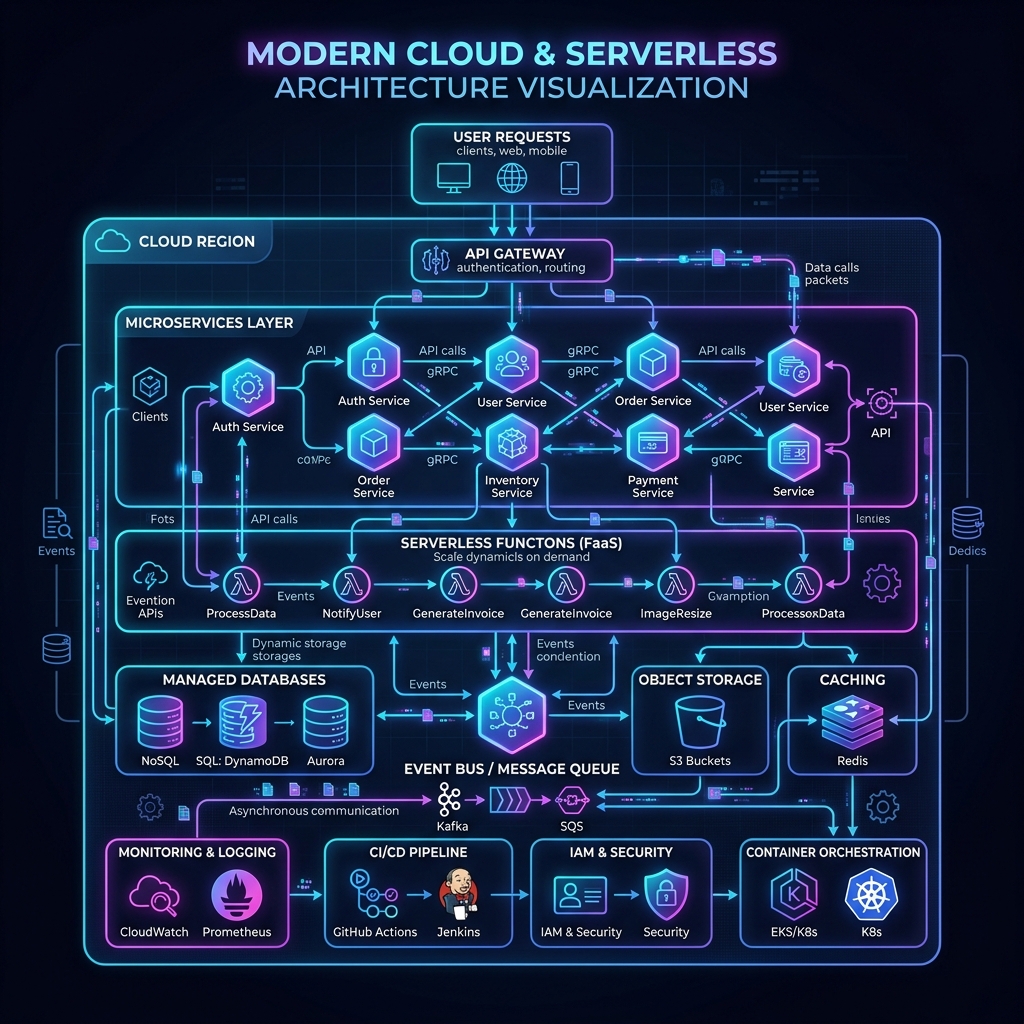
In today's fast-paced digital ecosystem, transitioning from legacy monolithic systems to modern cloud-native architectures is no longer optional—it is a business imperative. A well-designed cloud architecture ensures that applications are scalable, resilient, secure, and cost-effective.
1. The Monolith-to-Microservices Shift
Traditional monolithic architectures bundle all application components (user interface, business logic, database operations) into a single, unified codebase. While simple to deploy initially, monoliths present significant challenges as they scale: single points of failure, long deployment cycles, and technology lock-in.
Microservices solve this by breaking the application into smaller, independent, and loosely coupled services that communicate over standard protocols (REST APIs, gRPC, or WebSockets). Each service is responsible for a single business capability and can be developed, deployed, and scaled independently.
2. Event-Driven Architecture (EDA)
To ensure microservices remain truly decoupled, modern architects rely heavily on Event-Driven Architectures. Instead of synchronous HTTP calls (which introduce latency and cascading failures), services communicate asynchronously by publishing and subscribing to events.
For example, when a user places an order:
- The Order Service writes to its database and publishes an `OrderPlaced` event.
- The Payment Service and Inventory Service consume this event independently and process payment and stock updates concurrently.
- Technologies like Apache Kafka or AWS EventBridge serve as robust event buses to handle high throughput and message delivery guarantees.
3. Serverless and FaaS (Function-as-a-Service)
Serverless computing allows developers to build and run applications without thinking about servers. By executing business logic in response to events (e.g., AWS Lambda, Google Cloud Functions), developers only pay for the exact compute time consumed. This drastically reduces operational overhead, automates horizontal scaling, and optimizes resource utilization.
4. Continuous Integration and Delivery (CI/CD)
A resilient architecture is only as good as its deployment pipeline. Automated CI/CD pipelines (using GitHub Actions, GitLab CI, or Jenkins) ensure that every code commit is automatically tested, containerized (e.g., using Docker), and deployed to Kubernetes or serverless environments. This minimizes human error, decreases time-to-market, and allows for rapid rollback capabilities in case of deployment issues.